
Resume screening software

AI resume screening software for recruiters who are short on time

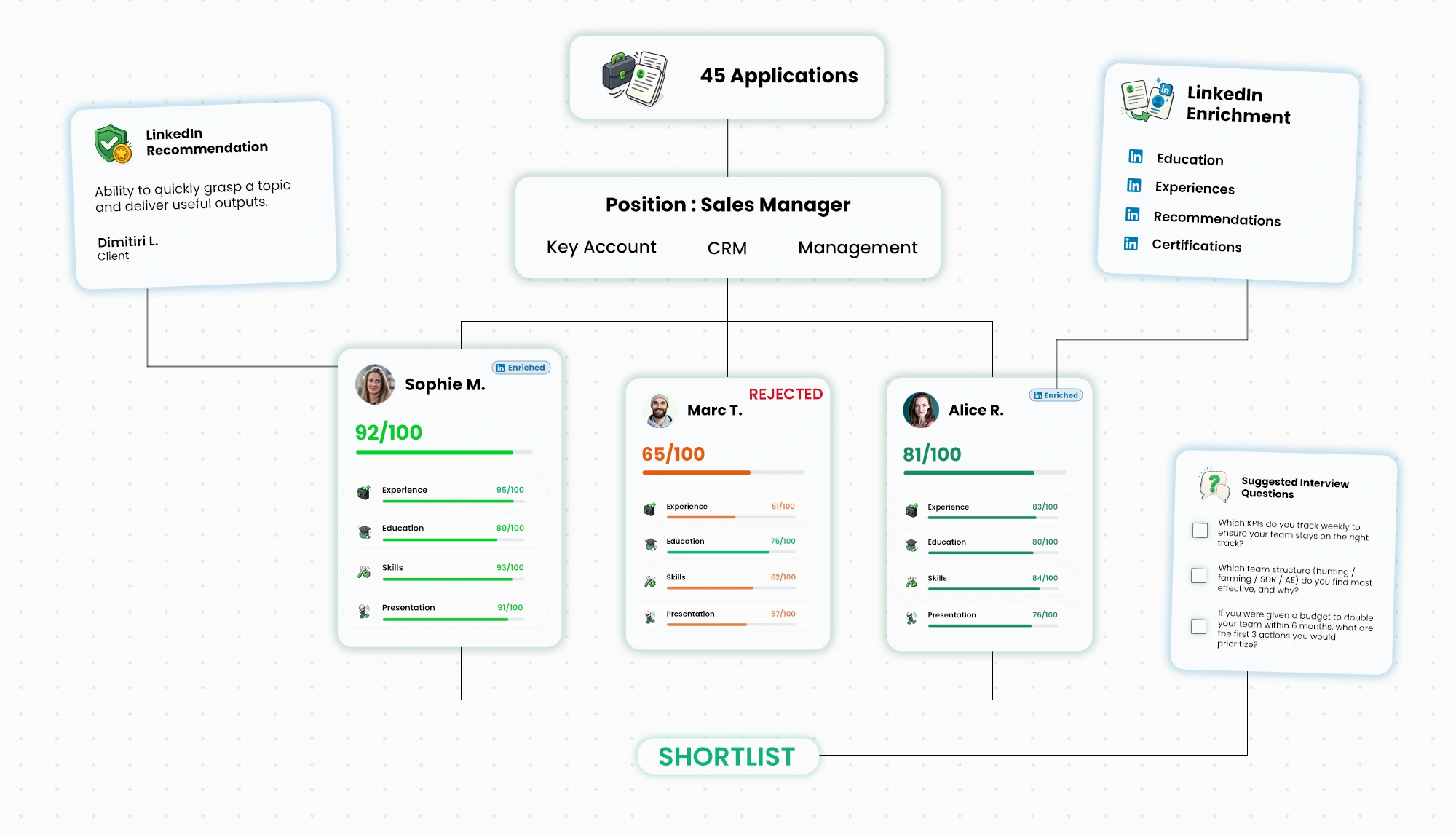
ResumeRank is an AI resume screening tool: it reads every CV in 30 seconds, compares it to your job description and gives it a score out of 100 with a written summary. Recruiters cut 80% of their screening time — 8 of the 10 hours they spend on it every week. From $29 per month.

Resume screening result in ResumeRank: score out of 100, detected skills and candidate summary
30 s
to read and score one resume
80%
of screening time saved
8 h
saved each week out of the 10 spent screening

What you get out of it

A score out of 100 for every candidate, not a gut feeling

Every resume is measured against the same criteria: job fit, technical skills, professional experience, soft skills and education. The ranking is reproducible, so two recruiters looking at the same pile see the same order — and you can explain a shortlist to the hiring manager.

Screening happens against your actual job description

Paste the job ad, drop in its URL or type the key skills: the tool pulls out the must-have and nice-to-have criteria, then weights the score accordingly. Software that sorts resumes without knowing the role is not really sorting anything.

You get a decision, not just a number

For each candidate: strengths, gaps, risk flags, a plain verdict (shortlist, consider, not relevant) and interview questions to ask. You move from screening to interviewing without rewriting a thing.

Data hosted and processed in France

Resumes are hosted and processed in France (Paris) under GDPR, and you remain the data controller. That is the difference between a European hiring tool and a general-purpose assistant that ships your applications elsewhere.

How it works

1

Create the role

Paste the job ad, its URL, or simply type the job title and the skills you expect. Selection criteria are extracted automatically and you can adjust how much each one weighs.

2

Drop in the resumes

Upload PDF, DOC or DOCX files, or let applications land by email from Indeed or HelloWork on an address dedicated to that role.

3

Read the ranking

Every resume comes back with its score out of 100, a summary and interview questions. Shortlist, hold or reject with a reason, then export the shortlist.

How do you automate resume screening?

Automating resume screening means replacing the quick skim of each PDF with a systematic assessment based on criteria you write down once. You define the role, the tool reads each resume, pulls out skills, experience and education, compares all of it to the job requirements and returns a score.

This is not keyword matching. A keyword filter rejects a candidate who did not use the exact term; AI resume analysis reads the context of a career and judges how deep a skill actually goes, so you stop losing good people over vocabulary.

Full automation starts when applications arrive on their own: through the WeRecruit API on the Enterprise plan, or through an email address dedicated to each role, which Indeed, HelloWork or a simple forwarding rule can feed. Every incoming resume is then screened and ranked with no data entry at all.

  • Define the role once: must-haves, nice-to-haves, weighting
  • Upload resumes in bulk, or plug in the role’s inbox
  • Let the scoring rank the pile, then read only the top of it
  • Export the shortlist as a PDF for your manager or your client

Automated resume screening vs manual screening

Manual screening costs time, but it costs consistency first. The twentieth resume of the day never gets the attention the third one did, and fatigue produces false negatives — usually on the non-linear profiles. Automated screening applies the very same grid to the first and to the two-hundredth file.

The second gap is traceability. After a manual pass you remember your conclusion, rarely the reasoning behind it. With a written candidate score you keep the per-criterion rating, the summary and the rejection reason, which makes a hiring decision explainable again — internally or in front of a client.

Automation does not decide for you. It gives you back the hours you spent opening files so you can spend them interviewing. The score ranks the pile; it does not hire.

Candidate pre-selection: the 100-point scoring grid

Pre-selection only works with a readable grid. In job-based analysis, the score out of 100 combines five criteria: job fit, technical skills, professional experience, soft skills and education. In standalone analysis, with no reference job, job fit drops out and the four remaining criteria carry the score.

Each criterion keeps its own rating next to the overall score, so you can see at a glance whether a candidate is technically strong but light on experience, or the other way round. The score comes with a plain verdict — shortlist recommended, worth considering, strong potential, needs work, not relevant — and a reliability flag on resumes too thin to be scored with confidence.

You can change the weighting role by role. For a sales hire, experience and soft skills weigh more; for an engineering hire, technical skills lead. That setting is what separates generic candidate scoring from pre-selection that actually matches how you recruit.

  • Job fit: how closely the profile matches the requirements of the role
  • Technical skills: command of the tools and technologies required
  • Professional experience: years of experience and relevance of the career path
  • Soft skills: communication, leadership, teamwork
  • Education: degrees, certifications and training

Resume screening software for agencies, SMBs and solo hiring managers

In a recruitment agency the hard part is not finding resumes, it is delivering a defensible shortlist fast. Screening software lets you work through a batch in an afternoon and produce a PDF report per candidate, scores and summary included, that the client can read without you in the room.

In an SMB, recruiting is rarely a full-time job: whoever screens the resumes also runs payroll, admin or sales. Software that sorts resumes gives those hours back, and gives them a number-backed answer for the manager who cannot see why a profile was not invited.

For a founder or manager hiring alone, the risk is deciding without a method. The scoring grid is the method: the same criteria for everyone, a summary per candidate and interview questions aimed at the grey areas in the file.

Free trial: what you can actually test

A trial answers one question: does the ranking the tool produces look like yours? Take a role you already filled, upload the resumes you received back then, and compare the top of the ranking with the candidates you genuinely met.

The free trial opens the core of the product: resume analysis, the score out of 100, the per-criterion breakdown, the summary and candidate comparison. Job-based analysis with bulk upload, PDF export and LinkedIn enrichment are detailed plan by plan in the pricing table below.

You move up a plan when your volume demands it, and the subscription is cancelled in one click from your account.

Manual screening, ChatGPT, a traditional ATS or AI resume screening software

Manual screening, ChatGPT, a traditional ATS or AI resume screening software
Manual screeningChatGPTTraditional ATSResumeRank
Time per resumeSeveral minutesVaries, one resume at a timeInstant but pass/fail30 seconds, full analysis
ObjectivityDepends on fatigue and reading orderA different answer on every runFixed rules, no nuanceThe same grid applied to every resume
Comparable scoreNoNot reproduciblePass or failScore out of 100, broken down by criterion
Matched to the job descriptionIn your head, never written downOnly if you paste the job ad every timeKeywords from the adCriteria extracted from the ad, adjustable weighting
GDPR and hostingDepends on where your files sitResumes sent to a general-purpose serviceVendor by vendorHosted and processed in France (Paris)
PriceThe hidden cost of your own hoursA general-purpose subscription, no scoringOften several hundred per monthFree trial, then from $29 per month
Pricing

How much does it cost?

AI resume screening is part of every plan: start with the free trial, then move up when your hiring volume asks for it. No commitment, cancel in one click.

Discovery

Perfect to try the tool and run your first candidates.

Free
  • 3 analyses / month
  • CV comparisons
  • Email support
  • Basic reports access
Start free trial

Founder's Offer

For HR teams hiring regularly. Limited to the first 100 customers - In exchange for this preferential rate, your feedback will help us build the best tool on the market.

$29 / month
  • 200 analyses / month
  • Job analysis (max 50 CVs/upload)
  • Unlimited job creation
  • LinkedIn data enrichment
  • Professional PDF Export & Logo
  • Advanced multi-candidate comparisons
  • Complete PDF reports + detailed KPIs
  • Priority support by the founder
Start free trial

Enterprise

For recruitment agencies and structured HR teams. Work as a team with a shared workspace.

€89 / month
  • 500 analyses / month (shared)
  • Team collaboration (admin + members)
  • Additional seats at €39/month each
  • WeRecruit API connection
  • All Founder features included
  • ATS integrations (Hellowork, Boond...)
  • Shared workspace
  • Dedicated support
Start free trial

Prices shown for monthly billing.

See full pricing details

Frequently asked questions

How does AI resume screening software work?

You create the role by pasting the job ad or typing the skills you expect, then you upload the resumes. The AI reads each document, extracts skills, experience and education, compares all of it to the criteria for the role and returns a score out of 100, a rating per criterion, a summary and interview questions. Budget around 30 seconds per resume.

Is automated screening as reliable as an experienced recruiter?

It is more consistent, not smarter. Software applies the same grid to the first and the two-hundredth resume, where a tired recruiter starts missing people. It does not replace the interview though: the score ranks the pile and prepares your questions, the hiring decision stays yours.

Does AI introduce bias into candidate pre-selection?

Scoring looks at skills, experience and education against the criteria you set in the job description, and applies those criteria identically to every file. A reliability flag marks resumes too thin to be scored with confidence. The best safeguard is still to read the borderline profiles yourself rather than trusting the ranking blindly.

Which resume formats are supported?

PDF, DOC and DOCX. You can also paste the text of an application, or import a LinkedIn profile from its URL when the candidate did not send a document.

Can ResumeRank connect to an ATS, to WeRecruit or to Indeed?

Yes. The WeRecruit integration connects with an API key on the Enterprise plan, and every new application is screened automatically. For Indeed, HelloWork or any site that sends applications by email, you activate an email address dedicated to the role and set it as the receiving address: attached resumes are analysed on arrival.

Is AI resume screening GDPR compliant?

Data is hosted and processed in France (Paris), encrypted at rest and in transit. You remain the data controller: tell candidates you use a pre-selection aid, keep a human decision at the end of the chain, and set a retention period for the applications you keep.

Ready to screen your resumes faster?

Start free trial