
Why Candidates Are Gaming AI Resume Screeners — and How to Catch Them
A perfect resume doesn't make a great candidate. Keyword stuffing, AI rewriting, inflated titles: optimization tactics are exploding. Here's how to spot the 'too good to be true' profiles.

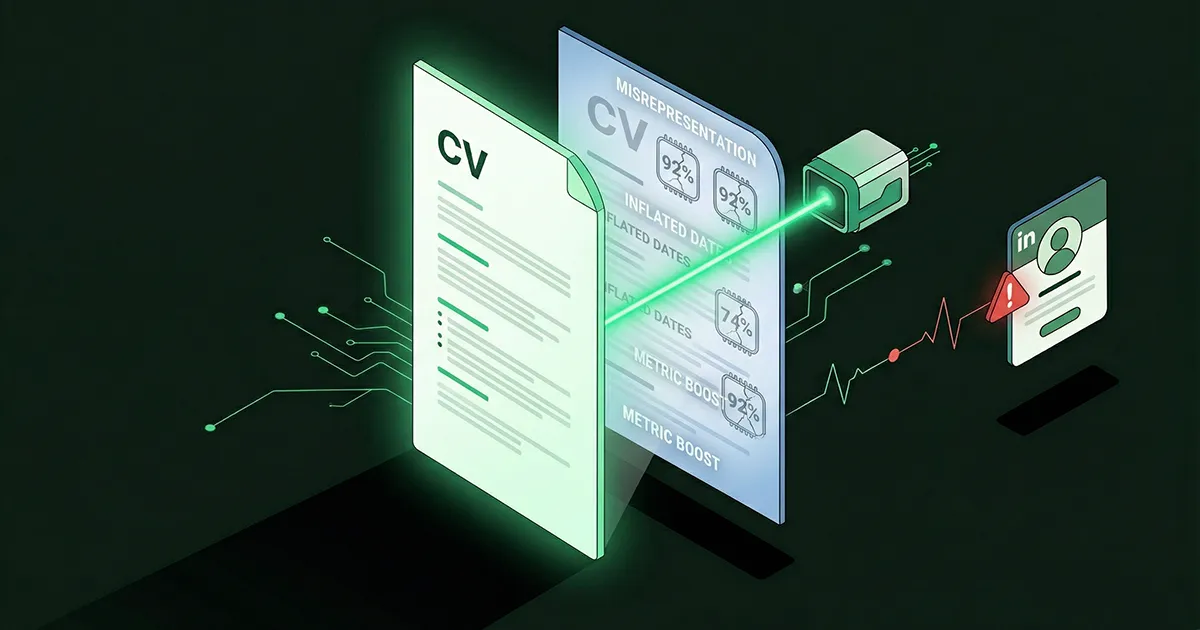
Recruiting in 2026 lives a fascinating paradox. On one side, AI helps recruiters analyze resumes faster and better. On the other, candidates use the exact same AI to optimize their resumes... to beat screening tools.
It's an arms race, and it's already underway.
Resume Optimization for AI: A Massive Phenomenon
The idea isn't new — candidates have always tailored their resumes to job postings. But in 2026, the tools at their disposal have changed dramatically:
What candidates do today:
- ChatGPT rewriting: paste the job description into ChatGPT and ask it to rewrite the resume for maximum matching. In 30 seconds, every bullet point is reformulated with the exact keywords from the posting.
- Invisible keyword stuffing: insert required skills in white text on a white background, or in PDF metadata. The ATS sees the keywords; the human doesn't.
- Title inflation: "Sales Assistant" becomes "Business Development Manager." "End-of-study internship" becomes "Junior Consultant."
- Dedicated tools: Services like Jobscan, Teal, or Kickresume analyze the job posting and automatically rewrite the resume to maximize the "ATS score."
The result: A recruiter recently told us that for a tech role, the top 15 resumes in their shortlist had nearly identical scores — because they'd all been optimized with the same tools. Scoring lost its discriminating power.
Why This Is a Problem (Not Just Self-Marketing)
There's a fundamental difference between "adapting your resume" and "optimizing for the system." The first approach is legitimate: highlighting relevant experience, using industry vocabulary. The second is problematic:
1. The resume no longer reflects reality When a candidate uses ChatGPT to rewrite their experience with invented metrics ("35% increase in conversion rate"), the document becomes marketing fiction.
2. Scoring loses its predictive value If 10 out of 15 candidates score > 80/100 because they all optimized with the same prompt, the recruiter is back to square one: manually re-reading every resume.
3. Truly great profiles get buried A senior developer who doesn't know resume optimization techniques can end up ranked below a junior who spent 2 hours on ChatGPT. That's exactly the opposite of what AI screening is supposed to produce.
5 Signals of an Over-Optimized Resume
Before discussing technical solutions, here are signals every recruiter should recognize:
Signal 1: Suspiciously Perfect Matching
When a resume seems to echo your job posting word for word, that's suspicious. A real professional uses their own vocabulary. An AI-optimized resume reproduces the exact phrasing from your job description.
What it looks like:
Job posting: "We're looking for someone with experience in agile project management, proficient in JIRA and Confluence, with a strong results orientation."
Resume: "Proven experience in agile project management. Proficient in JIRA and Confluence. Strong results orientation."
The reformulation is too literal to be organic.
Signal 2: Suspicious Metrics
Optimization tools systematically add numbers to "credibilize" achievements. But invented numbers often have recognizable patterns:
- Round, impressive percentages: "+40% productivity," "+60% conversion rate"
- No context: no mention of scale (40% of what? over what period?)
- Inconsistency with role level: an intern who "reduced costs by 25%" on an unspecified project
Signal 3: Uniformly "Corporate" Language
AI-optimized resumes have a recognizable style: every sentence starts with an action verb, every bullet contains a quantified result, the tone is uniformly professional. It's too smooth. Real resumes have irregularities, different styles across periods, personal phrasings.
Signal 4: Gap Between Resume and Interview
This is the most reliable signal, but it comes too late. A candidate whose resume is brilliantly structured but who struggles to explain their achievements in the interview has likely outsourced the writing.
Signal 5: LinkedIn Tells a Different Story
This is the key point. A resume can be rewritten in 30 minutes with ChatGPT. A LinkedIn profile with 5 years of history, manager recommendations, colleague endorsements, and dated certifications is much harder to fabricate.
The Solution: Multi-Source Verification
The best antidote against optimized resumes isn't a better matching algorithm — it's cross-reference verification. If the resume says one thing and LinkedIn says another, that's an objective warning signal.
How ResumeRank Detects "Too Good to Be True" Profiles
1. Automatic LinkedIn Enrichment For every candidate, ResumeRank automatically searches for their LinkedIn profile, scrapes it, and cross-references the data with the resume. The process is fully automatic, even if the candidate didn't include their LinkedIn URL in the CV.
2. Inconsistency Detection by Severity The CV/LinkedIn cross-reference generates alerts classified by severity:
| Inconsistency type | Severity | Example |
|---|---|---|
| Tenure discrepancy (> 1 year) | 🔴 High | CV: 2018-2024 / LinkedIn: 2020-2022 |
| Different job title | 🔴 High | CV: "Director" / LinkedIn: "Manager" |
| Uncorroborated skill | 🟡 Low | CV: "Salesforce Expert" / LinkedIn: no mention |
| Different company | 🔴 High | CV: "ABC Group" / LinkedIn: "Startup XYZ" |
3. Post-Scraping AI Validation After LinkedIn scraping, an additional Gemini 2.5 Flash call semantically compares the resume's experiences with LinkedIn's. If careers don't match, the LinkedIn profile is automatically rejected — preventing false positives.
4. Custom Weighting By adjusting criteria weights for each role, you reduce the impact of keyword stuffing. A candidate with all the right keywords but little real experience will be penalized if you weight experience at 40%.
What the Data Shows
From ResumeRank's latest test batch (9 resumes):
- 5 LinkedIn profiles found and validated — enrichment integrated into the analysis
- 2 profiles correctly rejected — LinkedIn profile didn't match the CV (different name or empty profile)
- 2 profiles not found — no identifiable LinkedIn profile, analysis based on CV only
- 0 false positives — no wrong profile was mistakenly integrated
The false positive rate dropped from ~15% to 0% thanks to the multi-stage validation pipeline.
How This Changes Your Process
Before (Standard Screening)
- Receive 200 resumes
- Score by keywords or simple AI
- Get 30 "top" candidates with similar scores
- Manually re-read to differentiate
- Conduct interviews only to discover 40% don't match
- Start over
After (Screening with Cross-Verification)
- Receive 200 resumes
- Score with AI using custom weighting
- Automatically enrich with LinkedIn
- Get 20 "top" candidates with verified skills
- Review detected inconsistencies BEFORE interviews
- Interview candidates whose claims you've already validated
The gain isn't just in time — it's in decision quality. You walk into interviews with the right questions (auto-generated from detected inconsistencies), and the candidate knows they can't hide behind an embellished resume.
Conclusion: AI That Verifies, Not Just Scores
AI scoring is a powerful tool. But in 2026, scoring alone is no longer enough. Candidates have access to the same LLMs as recruiters. They optimize, reformulate, embellish.
The real value of an AI screening tool lies in its ability to verify, not just score. CV/LinkedIn cross-referencing, inconsistency detection, semantic validation — that's what separates a useful tool from a reliable one.
A high score doesn't make a great candidate. A high score confirmed by LinkedIn is a significantly more reliable signal.
Want to automatically verify your next batch of resumes? Try ResumeRank — 7-day free trial, LinkedIn enrichment included.
Go further
Test AI scoring on your own resumes
Compare for yourself: scoring out of 100, LinkedIn enrichment, PDF shortlist. Free trial.
Try scoring for freeRelated articles
AI Talent Pool: Never Lose a Great Candidate You've Already Evaluated
Every resume you've analyzed is an asset. Discover how an intelligent talent pool automatically re-matches past candidates to your new positions, with zero extra sourcing effort.
Automatic LinkedIn Enrichment: Verify a Resume in 30 Seconds with AI
78% of candidates embellish their resume. Discover how automatic LinkedIn enrichment cross-references data in real time to detect inconsistencies and validate skills.