

Strategic hiringNovember 17, 20254 min read
How AI Helps Reduce Unconscious Bias During Candidate Screening
Unconscious biases distort our hiring decisions. Discover how well-designed AI acts as an objective filter to ensure a fairer and more effective process.

By Guillaume

No one wakes up in the morning thinking: "Today, I'm going to recruit unfairly." All HR professionals strive to be objective. Yet, we are all human. And our brain, to be efficient, takes shortcuts. These are the famous "unconscious biases," mental reflexes that push us to favor certain profiles without even realizing it.
Recruitment is a playing field particularly exposed to these biases. But in 2025, artificial intelligence, when well-designed, acts as a powerful safeguard to ensure a fairer and more effective process. Here's how.
The Problem Isn't You, It's Your Brain
Before seeing the solution, let's understand the enemy. When sorting through a stack of resumes, several biases can distort your judgment in just a few seconds:
-
Similarity bias: Our brain pushes us to prefer what resembles us. "Oh, they went to the same school as me" or "They're from my home region" can unconsciously enhance a candidate's value.
-
Halo effect: One positive detail (impeccable resume layout, a prestigious company logo) can make us perceive the entire profile as better than it actually is.
-
Origin or gender biases: Studies have repeatedly proven that a resume with a foreign-sounding name or a female first name could be penalized, without any objective reason.
The result? Atypical profiles or those from diverse backgrounds are dismissed, and the company potentially deprives itself of exceptional talent.
How AI Acts as an Objective Filter
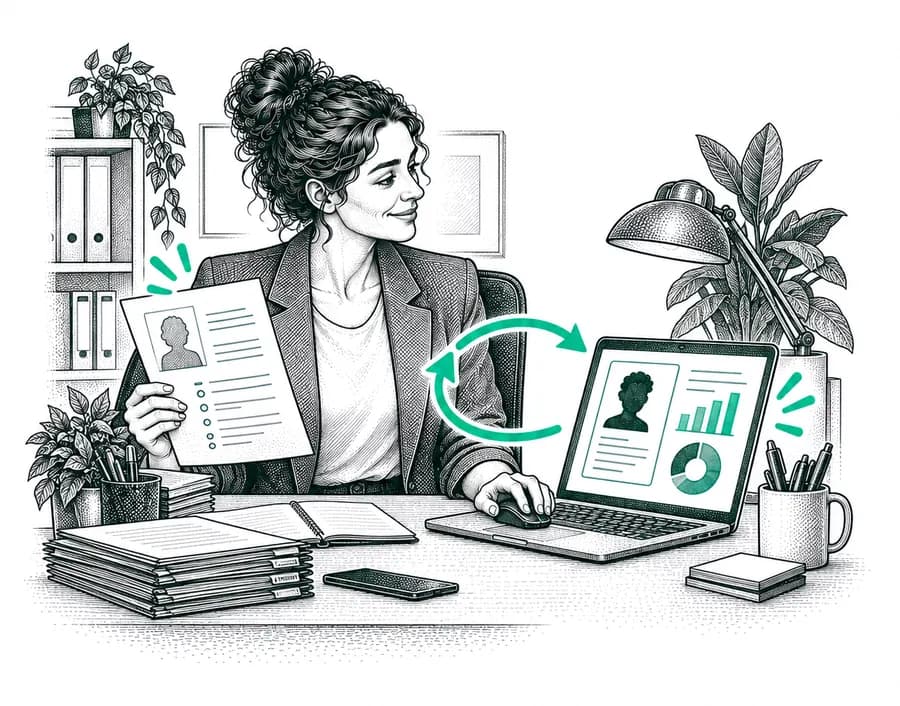
Far from being a magic black box, ethical recruitment AI like ResumeRank's applies very concrete principles to neutralize these biases.
1. A Standardized Evaluation Grid for Everyone
This is the most fundamental principle. AI applies the same rules of the game to all candidates. While a human recruiter may, unintentionally, slightly change their criteria as they read through a stack of resumes, AI uses a cold and immutable analysis grid.
Each resume is evaluated and scored based on objective criteria defined upfront:
-
Match of technical skills with the job description.
-
Number of years of experience in the required field.
-
Presence of key certifications or training.
A score of 82/100 means the same thing for the first candidate and for the hundredth. This standardization ensures that each profile has been measured with the same yardstick, creating a fair comparison baseline. This approach generates exceptional ROI for small businesses.
2. AI Focuses on What Matters (and Ignores the Rest)
This is perhaps where AI is most powerful. It can be configured to be deliberately "blind" to information that generates bias. A well-configured tool can:
-
Ignore the name, gender, or age of the candidate.
-
Disregard the address to avoid geographic biases.
-
Abstract from the layout or photo.
AI doesn't "see" a face or origin, it sees a set of skills and experiences. It focuses only on elements that are relevant for predicting performance in a position, and filters out the noise that could influence human judgment.
3. It Forces a Rational Decision, Not an Instinctive One
Biases arise from our quick and instinctive judgments (the "gut feeling"). AI, on the other hand, forces a slower and more rational decision-making mode.
By providing a detailed, quantified report for each candidate, it requires the recruiter to justify their choices based on concrete data. The discussion with a manager will no longer be "I have a good feeling about this profile," but "This candidate scored 90% on critical technical skills, which is why they're on the shortlist."
But Isn't AI Biased Too?
This is an essential question. An AI trained on biased historical data (for example, if a company has only hired men for a certain position) can learn and reproduce those same biases.
This is why ethical AI recruitment rests on two pillars:
-
Responsible design: Good tools are designed to actively correct these biases, by being trained on broad and diverse data and by allowing their results to be audited.
-
Final control remains human: AI is a decision support assistant, not an automatic judge. Its role is to present an objective and argued pre-selection. The final decision to meet a candidate always belongs to the recruiter, who can use this data to challenge their own intuitions. This is one reason why ChatGPT isn't enough for professional recruiting.
Conclusion: Putting Competence at the Center
Using AI to reduce bias is not an attempt to dehumanize recruitment. It's quite the opposite.
It's a way to ensure that the first door, the pre-selection stage, is opened as fairly as possible for all talents.
By acting as an "anti-bias filter," AI allows recruiters to focus on evaluating human qualities during interviews, with the assurance that the candidates in the room were selected for the right reasons. Ultimately, well-used AI does just one thing: it puts competence back at the center of the game.
Try our AI resume analysis and see how AI scoring eliminates bias from your pre-screening. 7-day free trial, cancel in one click.
Discover how ResumeRank ensures more objective recruiting — try it free.
Go further
Try ResumeRank on your own resumes.
Seven days on a real opening: every resume scored out of 100, with a summary and interview questions. No charge before the trial ends.
Read next
All articles
Guides and comparisonsOctober 9, 2026
AI Recruiting Assistant: Asking Questions About a Candidate's File
Product updatesOctober 9, 2026
October 2026 Update: Interview Reports, Debrief Notes and Iris

Guides and comparisonsMarch 28, 2026
Why Candidates Are Gaming AI Resume Screeners — and How to Catch Them