
Resume Analysis: Why ChatGPT Isn't Enough for Professional Recruiting
ChatGPT is an impressive tool, but using a generic LLM to analyze resumes has critical limitations. Discover why a specialized tool is essential.


The arrival of large language models (LLMs) like ChatGPT, Claude, or Gemini has caused a tidal wave in the professional world. LLM recruiting is on everyone's lips. For recruiters, the temptation is strong: why pay for a resume analysis tool when you can simply ask a generative AI to "analyze this resume"? It's a legitimate question, but one that ignores fundamental differences.
While ChatGPT is an impressive assistant for one-off tasks, using it as your primary resume analysis tool is like trying to build a house with just a Swiss Army knife. It's possible in theory, but the result will be fragile, non-standardized, and risky.
Here's a point-by-point comparison that explains why a specialized tool like ResumeRank is essential to move from "AI tinkering" to true recruitment performance.
1. Scoring: Vague Feedback vs. Objective Rating
The problem: Effective recruitment relies on comparative decisions. You need to know if candidate A is more qualified than candidate B for a specific position.
With ChatGPT: You'll get a qualitative summary. It will say the candidate has "solid experience," but what does "solid" mean? How do you compare this summary to the next candidate? You get an opinion, not a metric.
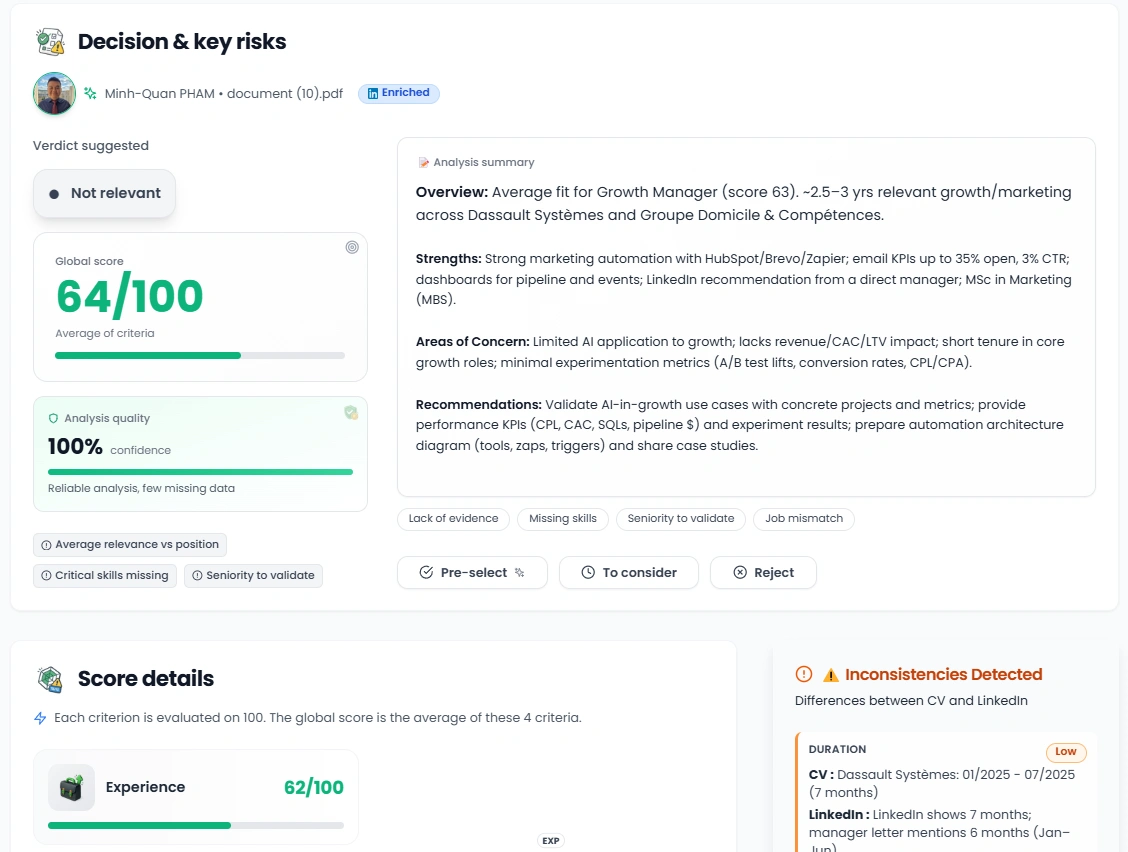
With a specialized tool (ResumeRank): You get a standardized score out of 100. Each resume is evaluated according to the same objective grid (skills, experience, etc.). One candidate gets 85/100, another 72/100. The difference is instantly quantifiable.
Why this is crucial: Without standardized scoring, you can't objectively rank candidates. You're forced to rely on your own interpretation, which reintroduces the subjectivity you were trying to eliminate.
2. Comparison: Manual Process vs. Comprehensive View
The problem: The final decision is made by comparing a shortlist of 3 to 5 finalists.
With ChatGPT: It has no structured memory. To compare three resumes, you must analyze them one by one, then open a spreadsheet to manually consolidate these paragraphs of text. It's tedious and error-prone.
With a specialized tool (ResumeRank): Comparison is a native feature. You select your finalists and instantly get comparative tables and radar charts. You visualize at a glance who dominates on which criteria.
Why this is crucial: A generic LLM is a solo tool, unable to provide the multi-candidate overview essential for informed decision-making.
3. Prompt Quality: Expertise Required vs. Built-in Reliability
The problem: The quality of an LLM's response depends entirely on the quality of the question (the "prompt"). A simple "Analyze this resume" will give a superficial result.
With ChatGPT: To get a relevant analysis, you would need to write a complex prompt including the job context, key skills to evaluate, exclusion criteria, and desired output format. This is a skill in itself, and few recruiters are "prompt engineers."
With a specialized tool (ResumeRank): Job configuration provides all the necessary context. Behind the scenes, the tool executes a sequence of optimized prompts to extract, analyze, and score every aspect of the resume. The process is invisible to the user but ensures reliable, standardized, high-quality results every time.
Why this is crucial: ResumeRank saves you from having to become an AI expert. It integrates this expertise to ensure consistently relevant analyses.
4. Objectivity: AI That Confirms vs. AI That Challenges
The problem: One of the biggest dangers in recruitment is unconscious bias.
With ChatGPT: LLMs have an agreement bias: they often seek to confirm the user's hypotheses. If you think a candidate is good, ChatGPT will find elements to validate your intuition, rather than challenge it. It can therefore inadvertently amplify your own biases.
With a specialized tool (ResumeRank): The algorithm is designed to be impartial. It applies the same cold, mathematical analysis grid to all resumes, regardless of name or origin. It acts as an objective safeguard against subjective impressions.
Why this is crucial: A specialized tool is designed to neutralize unconscious biases, ensuring a fairer and more equitable process.
5. LinkedIn Enrichment: Resume-Only Analysis vs. Automatic Cross-Validation
The problem: A resume only tells part of the story. Candidates may embellish their background, omit important details, or present inconsistencies between their resume and their public profile.
With ChatGPT: Analysis is strictly limited to the text you provide. If a candidate mentions their LinkedIn profile, ChatGPT will do nothing more than read the URL as text. It will never fetch LinkedIn data to enrich its analysis. You must do everything manually.
With a specialized tool (ResumeRank): The system automatically detects the LinkedIn link in the resume (~95% detection rate) and scrapes the public profile to enrich the analysis with data such as manager recommendations (social validation), validated skills (LinkedIn badge), recent certifications, publications and projects. The system also performs Resume ↔ LinkedIn cross-validation to automatically detect inconsistencies (dates, positions, companies) with severity alerts (High/Low).
Why this is crucial: This feature gives you +10-15% analysis quality improvement and allows you to automatically detect "embellished resumes" without having to manually verify each LinkedIn profile. It's a security feature that ChatGPT simply cannot offer.
6. Confidentiality and Data Sovereignty: Gray Area vs. Total Compliance
The problem: Resumes contain sensitive personal data protected by GDPR.
With ChatGPT: When you use the public version, you don't know where the data is stored or whether it's used to train the model. You're taking a significant legal risk.
With a specialized tool (ResumeRank): The platform is a secure GDPR-compliant environment. For total compliance, ResumeRank even offers the option to use the French AI model Mistral. This ensures that your candidates' data is processed in Europe, by a European player, providing a fully sovereign solution.
Why this is crucial: Trust is the foundation of recruitment. Using a tool that guarantees data sovereignty is a mark of professionalism and security.
Comparative Table: ChatGPT vs. ResumeRank
| Criteria | ChatGPT (Generic LLM) | ResumeRank (Specialized Tool) |
|---|---|---|
| Evaluation | Qualitative, subjective summary | Numerical score out of 100, objective |
| Comparison | Manual, resume by resume | Automated, multi-candidate |
| Prompt Quality | Required (variable results) | Integrated (standardized results) |
| Bias | Risk of bias amplification | Designed to neutralize biases |
| LinkedIn Enrichment | URL reading only | Auto scraping + cross-validation |
| Confidentiality | Unclear, high GDPR risk | Secure, sovereign option (Mistral) |
Conclusion: The Right Tool for the Right Job
ChatGPT is a formidable assistant. It's perfect for helping you rephrase a sentence or generate ideas. But it's not a recruiting tool.
For a professional, structured, and fair process, a specialized tool is a necessity. It provides the structure, objectivity, and reliability that generic LLMs cannot offer. It's time to move from experimental tinkering to a true AI-augmented recruitment strategy. The return on investment is exceptional.
Discover why ResumeRank is the most reliable resume analysis tool — try it free.
Test AI scoring on your own resumes
Compare for yourself: scoring out of 100, LinkedIn enrichment, PDF shortlist. 3 free analyses.
Related articles
Why Candidates Are Gaming AI Resume Screeners — and How to Catch Them
A perfect resume doesn't make a great candidate. Keyword stuffing, AI rewriting, inflated titles: optimization tactics are exploding. Here's how to spot the 'too good to be true' profiles.
AI Talent Pool: Never Lose a Great Candidate You've Already Evaluated
Every resume you've analyzed is an asset. Discover how an intelligent talent pool automatically re-matches past candidates to your new positions, with zero extra sourcing effort.